In case any of you are wondering, yes, I am still in Africa with the Peace Corps. I actually just came back from spending three days at the Sheraton hotel for my closure of service conference. I fully enjoyed the pool, hot showers, and all you can eat breakfast buffet that had bacon, sausage, and real cheese. It was a relaxing few days where we received tips on finishing our service (tie up the loose ends), preparing ourselves for going home. Apparently it is difficult for Peace Corps volunteers to adjust back to America. We also received resume tips, career advice, and provided feedback to Peace Corps staff.
I am coming to the end of my service. The official date is in November, but I may extend my time to help with training the new group of volunteers. Whether I extend it or not, I only have a little over two months at site which is hard to believe. The past year has flown by. I have not been good about writing, but the past year has been a busy year for me. The first year I had a lot of frustrations not finding work and adjusting to the culture. During this past year I still have a lot of frustrations but I now know how to navigate the system better. While some volunteers look back at their service as a negative experience, I feel that I taught people new techniques, and had accomplishments. I found good people with whom to work planting over 6000 trees. Another aspect of the past year has been the cultural aspect of Peace Corps, which tends to be a larger part of our experience such as working in the fields, sitting and talking, and brewing green tea (Gambia's national past time). Now that I know the language, I have had some interesting conversations about why men have multiple wives, and how America and The Gambia are different.
Out of my group of 25 environment volunteers, 9 have left the country early and 2 have extended for a third year to other countries (Jordan and China) that leaves 14 of us in country. I have debated with myself extending my service for another year, but I am ready to come home. As I said I may extend for training so I will probably be home mid January.
Friday, August 14, 2009

Saturday, January 17, 2009
Benin
I just got back from a week in Benin. For those you who never heard of it, it is a west African country near the equator. I have heard it is also where voodoo originated. Since the Gambia is mostly Islamic with few animist practices, I decided to go to Benin for the international voodoo festival.
.JPG) I really liked Benin. It reminded me of Brazil. When I stepped off the plane I was hit with a wave of heat and humidity (apparently it is the cool season. I cannot imagine how hot it would be during the other times of the year). Walking around town, I saw women carrying pineapples on their heads and cooking plantains on the sidewalks.
I really liked Benin. It reminded me of Brazil. When I stepped off the plane I was hit with a wave of heat and humidity (apparently it is the cool season. I cannot imagine how hot it would be during the other times of the year). Walking around town, I saw women carrying pineapples on their heads and cooking plantains on the sidewalks.I visited Grand Popo, a beach village. We camped on the beautiful beach, and watched a local NGO release sea turtles with school kids. We took a boat trip in the lagoons visiting fishing villages and watched fisherman throwing their nets for fish.
We next went to ouidah for the voodoo festival. We almost missed some of the voodoo idols because all around town are these cement mounds. We figured they were left over cement, but we saw men kneel before them and we found out the mounds protected spirits. We later went to the beach for the voodoo festivities. We saw a lot of dancing, drumming, and haystack spinning (local gods). We also saw men cutting their arms and heads with knives and then pouring alcohol on themselves. It was crazy.
.JPG)
Spinning haystack
We travelled a little up country hiking in the hills around Dassa, and visiting a restored king's palace, which had a throne resting on skulls of his enemies. Cotonou, the largest city, was a lot more developed than The Gambia with an extensive system of traffic lights, roads, and sidewalks. Unlike the Gambia there were a lot of cars, but in the cities there are no taxis. Instead people ride on the backs of motorcycle taxis. We received helmets from the peace corps office, but i was still a little nervous riding them. They would make left turns into sea of cars, trucks, and zems (as they are locally called). Many times I thought we were going to crash, but always as if it was the parting of the red sea, a hole would open up and we would dash through it.

Kristina and I at the beach with our motorcycle helmets
Work for the New Year
Last month was the mid way point of my service. Around Thanksgiving of this year I will be coming home. While it is a long way off, I think the time will fly by. Here are some of the projects I will work on until the end of the year.
- Elementary School - I want to continue working at the elementary school in the next village in the school garden planting trees and vegetables. I am working with a teacher on the use of the library and hopefully i can continue teaching environmental education to the older grades. We tried to do a play on deforestation to present to the school, but the kids could not remember their lines.
- Tree Nursery Competition - I am the co national coordinator for the competition in all the elementary and middle schools of the gambia. I work with representatives from the dept of Education, dept of Forestry, and the National Environment Agency to motivate schools to participate and plant as many trees as possible.
- Village sensitizations - I am probably the most excited about this project. I am building on work started by a peace corps volunteer last year. We will work in five surrounding villages planting central tree nurseries, and holding town meetings on the benefits of planting trees. The meetings will emphasize the financial benefits because I have realized while many people understand the enivornmental degradation aspect, the prospect of selling mature trees for cash will be a greater motivator.
While I have been frustrated with my work, I have a better idea of what I will be doing this year. Therefore, I think i will be able to accomplish more.
Thursday, December 25, 2008
FIRE - RUN
A few days before I came into the capital for Christmas, I helped fight (when I say fight, I mean mostly watch) a bush fire african-style.

The area between the villages has mostly short dry grasses so fires burn easily. In between the three nearby villages there are nothing but fields; by the way, I can see those villages at the distance from my village .
After breakfast, I started to make/fix the fence around my garden with the help of Mamadou, my counterpart in The Gambia. After 15 minutes or so, we saw smoke rising in the distance halfway between my village and the next; the villages are about 2km apart. My father and some of my host brothers took off, machete and rake in hand. Soon afterwards we saw the smoke greatly increased; thus my counterpart and I also took off toward the fire. When I got close I was very surprised. Boys and men were swinging branches with leaves to put out the fire. I could not believe they actually thought they could put out the fire with just leafy branches. Sure enough the wind picked up and the men realized they were no match for the fire.
We all headed back to the village and started to clear a firebreak of 2 meters around the village. I was trying to figure out how they were going to put the fire out. I thought maybe they would just let the fire die out on its own. However, by this point the fire was growing towards another village to the west of my village. I started to tell my counterpart we should widen the firebreak, but my counterpart told me to relax, that the fire would be taken care of. All of a sudden, boys in their late teens and twenties started to show up from everywhere carrying leafy branches. They took off toward the fire and started beating the flames and running along the fire line. Women started carrying water out to the fields, but instead of using the water on the fire, the men drank it.
I stood there not knowing what to do because I did not think they could do it; however, with help from all four villages, they succeeded in putting out the flames. Soon afterward everyone went home. Apparently fires happen every year so they are experts at putting them out. Last year was a rare event since there were no fires. I still find it amazing how the villagers put out the fire using only branches, but I guess that is what they have. There is no running water or fire service so they make do with what they have.
Merry Christmas, Happy Hanukkah, and Happy New Year
I wish everyone happy holidays and a happy New Year.
I spent Christmas in the capital (Banjul) with my friends, relaxing at the beach and eating good food.
I think this is one of the most difficult times of the year. This year more than last, when everything was still new, I really wanted to be back home for the holidays. I miss my family and friends, and here, there are no christmas lights, decorations, or music. At least I know next year I will be home for Christmas.
People in The Gambia have heard of Christmas, but know very little about it. They think of it as Tobaski for Christians. Tobaski is a big muslim holiday that we celebrated two weeks ago. I do not know its roots, but it is tied into the story of Abraham and Isaac in the Bible. On God's order, Abraham was going to kill his son, when God intervened at the last second, and told him to kill a ram instead. Therefore gambian families try to kill a ram for the holiday if they can afford it. My family killed two.
I think this is one of the most difficult times of the year. This year more than last, when everything was still new, I really wanted to be back home for the holidays. I miss my family and friends, and here, there are no christmas lights, decorations, or music. At least I know next year I will be home for Christmas.
People in The Gambia have heard of Christmas, but know very little about it. They think of it as Tobaski for Christians. Tobaski is a big muslim holiday that we celebrated two weeks ago. I do not know its roots, but it is tied into the story of Abraham and Isaac in the Bible. On God's order, Abraham was going to kill his son, when God intervened at the last second, and told him to kill a ram instead. Therefore gambian families try to kill a ram for the holiday if they can afford it. My family killed two.

My lunch
During Tobaski, everyone is happy around here. People dress up in their nice clothes, and do not work. My compound was really excited with the prospect of eating meat. This is one of the few times they have the opportunity to eat meat. Chicken, beef, goat and lamb are considered luxuries that most families cannot eat on a regular occasion. In my one year of living in village, I have eaten chicken twice, goat once, and lamb last year for tobaski with my host family. However, after three days of eating sheep for every meal trying everthing from intestines to stomach, I was glad to go back to the normal millet, peanut sauce and squash that we eat for two meals on most days.

My host mom (wearing an outfit from the fabric my american mom gave her) and my neighbor
Rainy Season Ending
 My host brother in the millet field
The rainy season ended a long time ago, but as you know I have failed to write in a while. The rainy season is the work season in The Gambia. My family goes out in the morning and afternoon almost every day from June until November. There is about a month break in August and September when the weeding is finished and people wait for the crops to ripen. My family grew peanuts called groundnuts, millet, sesame, and rice. I joined my family in the planting, weeding, and harvesting. After a morning and afternoon of weeding I do not envy their jobs. Farming is hard work and after a day of weeding by hand, all I wanted to do is crawl into the fetal position and not move. My lower back hurt badly after the day of bending over. It is amazing watching villagers especially the elderly women who weed for hours without rest bent over with their backs completely straight. (Gambians also grow watermellon, squash, and sweet potatoes.)
 My host family separating the peanuts from the dried groundnut plant
This year I convinced my family to grow rice. Rice normally grows in paddies with lots of water, but my village is not near a water supply. There is a new type of rice, NERICA or dryland rice, that can be grown with little amounts of water. I wanted to introduce it to my area so my father and I decided to try a small field this year. Looking back at it, I wonder if it was worthwhile because I spent most of the time arguing with my family about it. I had difficult'y getting them to help me weed and harvest; I think they considered my project, not a family affair. In certain places, the weeds ended up being taller than the rice because my host family would not weed and I refused to do it all on my own (too big a job). We also had a problem with cows eating the rice. The villagers herd the large cows but they let the calves roam free. I cannot understand why they let the calves roam and destroy part of the crops. My father told me people do not agree to herding them and that they do not destroy a lot. In the end, we put cow dung in water and spread it over the fields which kept them away. But, even with all the problems, the rice did produce, and my father is saving seeds for next year. If he plants it next year, I can call it a success so I am keeping my fingers crossed that he will.

Me in the rice field
Next to my house I had a rainy season garden growing cucumbers, squash, sweet potatoes, cassava, and tomatoes. My American pumkin failed miserably. It produced one big pumkin. I kept constant tabs on it and on the day I was going to pick it, it collapsed in on itself completely rotten. My biggest success was cucumber. Unfortunately my village did not like it. They would eat one small piece to be polite, but would not go back for seconds. I ended up eating seven cucumbers in three days and still had some left. I gave one to a lady who is always nice to me. She started to cut it and offer it to the kids, but they had already tried it in my compound the day before and refused. In gambian culture, people must always say food tastes good so she refused to give it back to me when I said I would eat it. She kept forcing it down. By the the squint in her eyes and the puckering of her lips, I knew she found it really sour.

My garden and polypots (orange, lemon, and mango)
Now the men are starting to relax because their work is done. They build fences from time to time, but for the most part they can go back to brewing attaya, green tea, in the morning and afternoon. I think attaya can be considered the national pastime in the gambia.

Me and my host brothers brewing attaya
Sunday, August 24, 2008
Termites
Oh and just for fun and as an experiment, we destroyed a termite mound.
The first picture shows the mound, after it was cut, resting on a tree (it was about 6 feet high)
The second picture shows it upside down on the ground.

Of course four days later, they had already built the mound back about a foot and a half.

Morocco
I arrived back from a vacation to Spain and Morocco, and for the past couple of days I have been a little down. It is difficult to adjust back to life after traveling, but in the next couple of days I should get back into the swing of things.

Snake charmers in Marrakech
I had a great time walking around the cities in Morocco. There were some small problems such as my bag not showing up for four days and feeling sick for the first week, but I enjoyed taking a break from The Gambia and forgetting about my frustrations and concerns. Morocco was not exactly what I expected. I thought I would see tilework, arches and architecture influenced by the Moors. Instead I only saw it in the Marrakech museum.

Mosque in Casablanca

Shops in Chefchauoen
Another highlight was Chefchaouen, a town in the mountains, made famous by its blue doors and buildings. I had a great time wandering around the small streets admiring the buildings and views of the valley.

The walled medina in Essouira
Most Moroccan cities have a medina, a walled older section. The areas are packed with buildings and shops. Each city is unique, from the waves breaking on Essaouira's city walls to Marrakech's dates, spices, and freshly squeezed orange juice. Every place was interesting; if I go back I will spend some time in the mountains. We planned to go to one village in the mountains, but we had to cut it out of our plans due to our bag situation.
Work
During the raining season, people in village work a lot. It was almost as if the rains flipped a switch and everyone started to work. They have to do it because this four month period is when they produce all the food that will feed them for the rest of the year. What surprised me was the fact that people were also more interested in doing the environment projects I have been encouraging people to do. My counterpart built a fence out of branches and logs which is unheard of. He has been talking about it for four months, but since he never did anything I did not take him seriously.

Painting the library
One teacher and I painted the school library, and my jaw dropped when I walked in the library to see that the school folks had arranged the books without my knowledge. My father and I planted cuttings, branches of trees that when planted will grow into a tree, to make a fence, and he immediately agreed to help me plant my trees in polypots in the fields.

School kids planting cuttings
 Amadou in my garden
Rain, Rain, Rain
One night, I woke to the rattling in my roof. I lay in bed listening to the pounding of the rain and the increasing strength of the wind. My metal corrugated roof made so much sound I was convinced my roof was going to blow away. I flashed my light around looking for leaks. I found one spot where the water pooled and dripped through my rice bad ceiling. I placed a bucket to catch the water and tried to fall back asleep attempting to put aside my worries of the roof.

Storm clouds are approaching
In the morning I woke to find a skylight. One sheet of corrugate folded over causing light to shine inside my house. I considered myself lucky because when I went outside to survey the damage I saw one man's roof completely blown away and my host brother's grass roof fell off. My roof was an easy fix and I survived my first rain storm in village.
This storm was one of the many storms I have seen come and go. The rainy season lasts from June to September. During the month of August it rains almost everyday. I like the rainy season more than the hot/dry season. The rains bring a cool breeze and the barren wasteland turns green. Walking to the next village, I felt as if I was in a golf course due to the thin layer of green and scattered trees. Now the weeds are over head high. The rainy season is also the work season. Everyone plows, plants, or weeds the fields in the mornings and evenings almost everyday until the end of July.

Woman walking through a field
When it is rainy I usually go inside my house and read to wait for the storm to pass. Most Peace Corps Volunteers spend a lot of time reading during the rainy season.
Sunday, August 3, 2008
Lolo's' views of life in village
A few highlights about what I (Alex's Mom) understand of life in village:
- Alex’s family is from the Fula tribe, which are typically not so dark (even though his family seems very dark to me). They speak Pulaar and Wolof in the village. Alex was taught Pulaar, which is not as spoken as Wolof; he says he wants to learn Wolof (used for business) too. Folks speak many of the languages/dialects. African languages are not written, thus very hard to learn.
- Families live in a compound, i.e., multiple houses or shacks – some are individual, some are long houses, with multiple single rooms. They are organized in a circle or square with room in the middle for the mingling.
- Multiple family compounds make a village. Alex’s village has 7 compounds, thus, very small. They have only about 60-70 people.
- Men and women don’t live together. Boys >15 and men have their own “houses (or rooms)”. Women sleep with their children in one “house”. Women visit their men during the night; I don’t know the protocol among the wives.
- Each house has one room, fairly small, sometimes with a separation to make it into 2 rooms. Their one piece of furniture is a double bed typically covered with pretty African cloths as bedspreads; they all have it. I think the clothes are kept in trunks; no tables nor chairs. Alex had 2 chairs for us.
- When we entered Alex's room, we were greeted by 4 frogs and 1 big gecko... I guess they come in during the day time (since it is too hot out) and go out in the night. I could hear rats scurrying in the roof in the middle of the night. His roof is corrugated aluminum with rice bags and straw in the inside to break the heat, I believe.
- Typically a family compound houses families of 2 brothers.
- They are muslims, thus polygamous (can have up to 4 wives). In Alex’s host family, his host father has 2 wives and his uncle also has 2 wives. Between the 4 women there are 24 children. So, there are kids galore, of all ages, mingling around and playing in the dirt
- Women cook, clean and take care of the kids. Men plant, buid houses and fences. Kids do all kind of chores. Women and boys fetch the water from the wells.
- There is no running water nor electricity.
- Food is mostly rice or coos (i.e., millet) with some sauce and a small fish – for breakfast, lunch and dinner.
- They eat with their right hand out of common food bowls; the left hand is the “dirty” one used for cleaning their privates. Men have their own separately from the women and children. Alex eats with his host father (who has a separate bowl in his family) and they gave us our own food bowl (most times we actually had two big food bowls which gave us a problem since we were supposed to eat well to show we liked the food). I have to admit we did use spoons most of the time when we ate in Alex's room (except for Alex).
- They do very little between 11am and 4 or 5 in the afternoon during the dry season; mostly lie in bed or sit under the mango trees in the shade – it is too hot. In the raining season (June through October) they plant and weed.
- In the late afternoon and evenings they sit outside, each family together, near the Dad’s shack; teen boys can sit by themselves in another location. Don’t know the schedule for cooking between wives but they prepare the food and bring the food bowls. Since there are no lights, the stars are bright; it felt like camping… beautiful. People sit together and sometimes chat. They either sit/lie on mats or benches until midnight or so (but I think they also sleep during this time since they get up early for prayers).
- They cook in small stoves in the back of their houses, using wood for fuel; typically in a covered area. The backs of the houses have a little area which is fenced. There is where they cook and wash clothes and themselves; they use buckets or large basins.
- I don’t know where they go to the bathroom; Alex says they are supposed to go on the fields. In Alex’s village there are 2 pit latrines: his and his Dad’s. His is in the back of his house, fenced. His Dad’s is a separate building. While I was there I never saw anyone peeing or pooping (a mistery).
- They drink lots of ataya, a very sweet version of a green tea, which takes a long time to prepare.
- They chew a type of stick that is good for their teeth; they don’t go to the dentist and most seem to have good teeth.
- They sweep their rooms twice a day and, at the end of the day, they sweep/smoothen the area inside the compound. During the day the kids play around and the animals (goats, cows, chickens) roam free during the dry season; so they were all amongst us.
- So the compound is clean but the areas outside the compound have all kinds of trash. Apparently they have an area delineated for trash (which I think they burn once in a while) but keep in mind they don’t have much, thus very little trash. And they use/reuse a lot.
- When the wind picks up, there is sand/dust everywhere.
- The kids are filthy because they play in the dirt but I think they are washed at night because I have seen many of them pretty clean except for the feet.
- The girls have their hair in braids most of the time and the women wear the head turbants.
- Women wear long skirts all the time but shirts are optional; since most of the women are feeding babies most of the time, exposed boobs are no big deal.
- Greetings are very important in their culture. Every time they meet someone, they spend about 3-5 minutes in greetings (How are you? How is your family? How did you sleep? etc)
- They spit a lot; it is part of the culture.
- The women and girls carry the young in their backs, with a piece of cloth that ties up front. They do their chores (carrying water in their heads or pounding coos) with the babies in their backs.
- They ask for things all the time (it drives Alex nuts), like food, candy, band aid, ataya, etc… and they ask each other too.
- The school is in the next village; unfortunately, only 5 children from Alex’s village go to school. They feel there is no point since there are no jobs around.
- Schools are taught in English; they also teach Arabic. Children wear uniforms and walk to school everyday; they provide lunch but the kids are supposed to pay a token fee for lunch, and also for the school year. Girls can go to school for free, if they choose to (order of the government). Their schools are not very good; they learn everything by recitation. Alex is now helping at the nearby school, teaching them math; he started math’atons to get their interest raised. The school buildings were built by NGOs (external help to Africa).
- When we visited Alex's school, they put up a play about a Gambian wedding - lovely.
- Many of the villages have mosques and they wake them up for prayers at 5:30am using loud speakers. Alex’s village didn’t have loud speakers.
- They have leaders, the village alkalo; Alex’s Dad is the alkalo of his village.
- They have community groups but mostly to discuss issues. There isn’t a sense of community to improve their life style or their villages. We found them very complacent, with no motivation for improvement.
- Their knowledge of the world is almost none since they live so isolated. But things are changing. Alex’s oldest brother lives in the Kombo area and works as a manager for a hotel; so he left the village and now has a better understanding of the world; besides, he makes good money for Gambians. He brought a solar generator for the village and installed in the younger brother’s house. So they have some electricity and can charge all kinds of things, including boom boxes. They have an old black and white TV that the children watch 2 nights a week (powered by an old car battery); the problem is that the programs are either in French or English which is not spoken in village. So, they mostly watch the images; however, as they watch more TV, they will start learning the language and more about the world (then the culture will start to change, or at least the desires).
- Most of the older guys have cell phones, which operate with bought cards.
- There is dust everywhere due to the sand and wind around the area. Everything in the rooms have a coat of dust; it gets into everything. Alex is keeping his camera in Ziploc bags inside a trunk.
- They are extremely friendly. They love music and to dance, especially the women. They play drums with pots and pans, gather in a circle and they dance, one at a time. We had a chance to hear and dance with them. They also asked us to dance and Karina suggested the macarena, done by 4 PCVs, K and Lolo and the children also joined us - fun!
- They have so little that anything is of interest to the children, like a magazine, a toy, or candy. They are extremely curious. We brought some pictures and they just loved them.
- If someone goes out of the village, it is customary to bring some present back, whether a mango, kola nuts, or a vegetable.
- Most of them are very good looking, with some women with beautiful features.
- They laugh a lot; they seem quite happy most of the time, especially the women.
- Even though we couldn't talk to them due to the language barrier, they were very hospitable. We had heard that the gambians are a very hospitable people; any visitor gets food and board.
- We really enjoyed visiting Alex's host family and experiencing his day to day life in the Peace Corps. It will stay in our memories for a long, long time.
Silvester family adventure in The Gambia
John, Karina and Lolo (Alex's immediate family) went to visit Alex in The Gambia in June 2008, just as the school year finished in the US. It isn't the best time to visit - probably the hotest time of the year - but we had no choice. We were anxious to see Alex and visit the country. We had read Alex's blog and the blog of other PCVs and had chatted with Alex on his cell phone quite a bit, so we sort of knew what to expect (well, most of the time).

If you want to see pictures of our trip, go to http://picasaweb.google.com/jasilvester
We had a great time but, we have to confess that it was an adventure, traveling by boat and "old" van (through good and horrible roads), seeing beautiful landscape along the river, watching birds (John counted 99 different species), seeing children galore and very dry and desert-like conditions where Alex lives. We saw very poor living conditions but no one starving; in fact the gambians are beautiful people; we saw very tall men (taller than 6 feet) and women. There is one major town, a few small cities with electricity, but mostly villages with no electricity, and wells for water. It appears that most of the country has cell phone coverage, so it will be interested to see how they evolve as they get more communication and global news. Solar chargers are starting to get into use in many of the locations.
We spent 13 days in The Gambia and traveled up river with Alex. Alex said other parents may want to travel there; thus, here was our itinerary:
- 2 days in the Kombo area
- One day going up river (car and boat)
- One night at Tendaba Lodge
- One day again going up river (boat, car and boat)
- 2 nights at Bird Safari camp
- 1 night at Chimpanzee project
- 3 nights at Alex's village
- 2 nights in Gunjur (south Gambia)
We used a travel agency called Hidden Gambia; feel free to check out their site at http://www.hiddengambia.com/ for descriptions of the tours and nice pictures of the area.However we did try to take the bush taxi from Alex's village; another one of our adventures.
Adventure story: We left the village in the dark (5:30am) and walked to the next village (bout 1 mile away), on the narrow trail, carrying our bags, to catch the gele-gele (bush taxi - a big van where you pay $1 per person for the 50 kilometers to the ferry crossing); our head-lamps and flashlights were put to use and the starry sky was beautiful. Unfortunately, the gele came full and half of the people waiting for it jumped in (we don't know how they fit). We sat on the sidewalk on their main square, and Alex said that, in the worst case, we would hire a donkey cart to take us to the main road where we could take another gele. We had no idea how we would end up traveling; some said another gele would be coming in a "little" while. About 20 minutes later, out of the blue, a very old car showed up and offered to take us for $2.5 per person... they know how to deal with tourists. We believe one of the locals called this guy. Well, the car made it and we got to the ferry safe and sound - another adventure.
If you want to see pictures of our trip, go to http://picasaweb.google.com/jasilvester
Instead of boring you with too many details, we will just post some highlights.
Overall impression. The Gambia is a small country with very few resources (mostly peanuts, tourism and fish); you probably know that it follows the Gambia river. It is a very colorful country, the people are extremely friendly (with a few exceptions, described below), its Atlantic coast is beautiful and the river is long and totally unused (from our perspective). The difficulty is to identify their possibility of growth; apparently most of their youth want to go to Europe or America to seek a better life. Deforestation is another big problem; they went from 85% forest to 15% in the last decade; and of course the poor farmers in village do not understand the issues. The agfo PCVs (like Alex) are doing their best to help them but it is difficult when they don't really understand it.
Highlights of our visit were the Chimpanzee Visitor Camp (described below) and Alex's village.
“Badi Mayo, the Chimpanzee Visitor Camp http://www.chimprehab.com/visitor_camp/) is located 270 Km up-river in the Gambia River National Park. It is managed by the Chimpanzee Rehabilitation Trust (CRT) - Africa's longest running and perhaps most successful project for rehabilitating chimpanzees to the wild. The project was founded by Stella Marsden whose father, Eddie Brewer, was a forestry officer and a keen conservationist. He later became the first director of the Wildlife Department in The Gambia and was responsible for establishing the Abuko Nature Reserve. For a long time completely off-limits to visitors, Stella has recently decided to offer chimp-watching trips to small groups of interested tourists, in an effort to safeguard the project's financial future. It’s a thrilling opportunity to view habituated chimps in a pristine natural environment.” We paid $150 per person to stay there for one night (full board and boat rides), on a very fancy tent perched high up at tree level on wooded platforms overlooking the river.
The area was beautiful but it was extremely hot - it seemed we were in a sauna for 5 hours until late afternoon – that was no fun. The boat ride to the island in front to see the chimps, on the other hand, was great. No one steps on the island; from the boat, we fed one of the groups that had: a big guy, the Alpha leader, many ladies with their babies and other macho types and children (so cute). They fed them bread, beans and nuts. It was fun watching them. When they came by the shore, the boat was docked at a safe distance; one of their leaders pulled a couple of sticks (thick ones) from the trees and threw them at us – to show off his strength… They were pretty big branches… They also had baboons on the island that ate the leftovers of the chimps; they sat on the trees down river since a lot of food fell in the water while being thrown (and missed).
Then the boat continued navigating on small water channels they call little Africa; very pretty. We even saw a barn owl. John took great pictures of birds along the trip.
The food was great; the tents, perched on a hill, were beautiful but very hot. Definitely it wasn't the best time of the year to travel (we knew that) but it was a great experience.
The area was beautiful but it was extremely hot - it seemed we were in a sauna for 5 hours until late afternoon – that was no fun. The boat ride to the island in front to see the chimps, on the other hand, was great. No one steps on the island; from the boat, we fed one of the groups that had: a big guy, the Alpha leader, many ladies with their babies and other macho types and children (so cute). They fed them bread, beans and nuts. It was fun watching them. When they came by the shore, the boat was docked at a safe distance; one of their leaders pulled a couple of sticks (thick ones) from the trees and threw them at us – to show off his strength… They were pretty big branches… They also had baboons on the island that ate the leftovers of the chimps; they sat on the trees down river since a lot of food fell in the water while being thrown (and missed).
Then the boat continued navigating on small water channels they call little Africa; very pretty. We even saw a barn owl. John took great pictures of birds along the trip.
The food was great; the tents, perched on a hill, were beautiful but very hot. Definitely it wasn't the best time of the year to travel (we knew that) but it was a great experience.
We will talk about the village in another post.
Friday, June 13, 2008
Family Visit
I just arrived back from a trip to Spain. My parents spent 12 days in The Gambia and then we went together for one week in Spain, a few days in Madrid and a few days in Barcelona. It was great to spend sometime with my parents and my sister and to take a break from Gambia. Unfortunately I, the experienced Gambian, got bad diarrhea in the airport leaving for Spain. Just as I thought I would be able to eat whatever I wanted, I could not do it at first. Luckily it only lasted two days, and for the rest of the week I treated myself to all sorts of food I had been missing such as steak (without bones), ice cream, and cheese.

Eating "tapas" in Barcelona
While in Gambia, my parents and my sister stayed a few days on the coast, traveled up river to Tendaba and Bird Safari Camp in Janjanbureh, and visited my village for 3 nights; they lived their Gambian adventure. While here, they saw first hand the good things and some of the frustrations and challenges Peace Corps volunteers have in the Gambia. I think they had a good time seeing where I live, but by the end, they were ready to leave. I invited them to do guest posts so I will let them explain their adventures such as taking pictures of beautiful birds, our 2 boat-2 car rides in the heat of the day, sitting in the shade dripping in sweat, and feeding the chimps (a once in a lifetime experience).

When we showed up at chimp island, one of them threw a big stick at the boat barely missing one of the guides to apparently show who was the boss. It was amazing watching the chimps smiling at us, holding out their hands, and catching food thrown at them (beans, bread and nuts). At one point, one chimp pushed another one in the water (again showing strength). When the wet one came out of the water, one of his brothers gave him a hi five - like he was supporting him. It was amazing to see the similarities between them and humans.

Feeding the Chimps
When we showed up at chimp island, one of them threw a big stick at the boat barely missing one of the guides to apparently show who was the boss. It was amazing watching the chimps smiling at us, holding out their hands, and catching food thrown at them (beans, bread and nuts). At one point, one chimp pushed another one in the water (again showing strength). When the wet one came out of the water, one of his brothers gave him a hi five - like he was supporting him. It was amazing to see the similarities between them and humans.
Other highlights:
My mother dancing with one of my Gambian mothers at their naming ceremony

Eating local food (bread with beans) and tea

Teaching the kids the macarena - in village
Sunday, June 8, 2008
Training
About a month ago, I had more training in Kombo, the capital area. We learned about a variety of project ideas.
- I went beekeeping and harvested four hives in one night. I did not get stung, but I was covered in bees.
- I attempted to graft a mango tree. Luckily i did not cut my finger like others in my group. If done correctly we could make lemon, lime, and grapefruit tree or a mango tree with different varieties.
- I made a grass hive. The great advantage of those is that it does not cost anything and the materials can be collected in the bush. (Keep in mind villagers have basically no money so reusing raw materials is a must).
MANGOES

People say the best time in The Gambia is mango season which I recently experienced. Everywhere I look there are mangoes of different shapes, colors and sizes. I am told there are so many mangoes that most go to waste, but in my village that is not the case. When a mango falls, the kids burst off running because they go by the finders keepers rules. If they are too slow, a nearby cow may gobble it up instead. It is almost as if the kids have a sixth sense. They are off and running before my mind processes the thud. Therefore, I have never made it to a mango first, but the kids in my compound will give me some.

They were posing for a picture when a mango dropped and off they went.
One night I was sitting in the middle of my compound with my family when I heard a thud and clang on the corrugate metal roof. The kids took off running. I had no idea what happened to make them run; then I realized a mango had fallen from the tree, bounced off the roof, and landed on the floor. Since they had no flashlight, they couldn't find it. A little later one of the elder sisters joined the hunt with a flashlight. Then someone found it; and ate it.

At first I was nervous to eat mangoes because I used to have an allergic reaction to the mango skin. After a few weeks I decided to go for it; it was too tempting. Now I know why none go to waste in my village. They are really good. My record is five in one day and so far no allergic reactions.
Tuesday, April 29, 2008
All Work and No Play
That is not really true. As peace corps volunteers technically we are always working in village, but we do have time to visit other volunteers, hang out, and have some fun. For Saint Patrick’s Day many of us in my environment group went up country to visit one volunteer at her house. We hung out for a couple days relaxing and sharing experiences about village. We all had been in village about four months and had gone through a lot. It was great to hear everyone’s different stories.
 We decided to have bush pig, and we paid a local hunter to have the back half of a pig. We skinned it and smoked it over a fire. We were lucky to have with us an animal science major who is skilled in butchering meat. After we cooked it, the meat looked great. It was a golden brown and juicy on the inside. We were all excited to have some meat because meat is a rare occurrence in our families’ food bowls, but we should have known there was something wrong by the smell, slighlty rancid. We thought it was the fact that it was bush meat, but when we tried the meat it had a consistency of blue cheese. Only one section tasted okay. We decided not to risk it and threw most of the meat out. We are not sure what went wrong, but we learned not to let the meat sit overnight and cook it the next morning.
We also learned about a rabbit breeding project for meat. The peace corp volunteer has tripled the amount of rabbits she has in four months. One cool thing she created was beer bottles and sardine cans for water bottles. They work really well and they are cheap.
We decided to have bush pig, and we paid a local hunter to have the back half of a pig. We skinned it and smoked it over a fire. We were lucky to have with us an animal science major who is skilled in butchering meat. After we cooked it, the meat looked great. It was a golden brown and juicy on the inside. We were all excited to have some meat because meat is a rare occurrence in our families’ food bowls, but we should have known there was something wrong by the smell, slighlty rancid. We thought it was the fact that it was bush meat, but when we tried the meat it had a consistency of blue cheese. Only one section tasted okay. We decided not to risk it and threw most of the meat out. We are not sure what went wrong, but we learned not to let the meat sit overnight and cook it the next morning.We also learned about a rabbit breeding project for meat. The peace corp volunteer has tripled the amount of rabbits she has in four months. One cool thing she created was beer bottles and sardine cans for water bottles. They work really well and they are cheap.
Meetings, Meetings, Meetings
"Can you draw a map of the village?" "We do not know how. "
"What is good about the village?" No answer.
"On what have you worked together on?" No answer.
"What are you proud of in the village?" No answer.
"What would make your life better?" Long pause…"A milling machine and garden."
"How will we build a garden?" "We do not have the means to build a garden. "
This is how one of the most discouraging meetings of my life went. I held a women’s meeting in my village through a translator. The women did not have answers for any of my questions. I could not believe they had nothing to say. I wanted to have a discussion about the village to learn what are their challenges and accomplishments so we could work together to improve the village, but they had little to say. When I told them I can provide knowledge and information but lack money to give them, they said "what is the point of having your knowledge and skills if there is no place to use them".
After the women’s meeting I was depressed and it took me the rest of the afternoon to recover. The situation seemed so hopeless. I did not know what to do or how to make their lives better. After talking to some other volunteers, I realized analyzing ones life and looking at what is good and what is bad is something Americans do their whole lives. We are taught and grow up in a society that is constantly self evaluating itself. The women in my village who never went to school have probably never been to school or been asked questions like the ones I posed. They live from day to day.
I decided I would write a grant for a women’s garden. The grant would include money for barbed wire fencings and a well. The water table is about 36 meters which is extremely deep for The Gambia. After talking it over though, I decided against writing the grant because everyone kept asking me how do you know they really want a garden, will use it, and maintain the fence when it breaks. It was true I had no indicators they would. My village has no women’s group. When I tried to teach them about mud stoves, they were not interested in learning or making them. They only wanted me to build it for them which is one of the major problems because when the volunteer leaves, the projects fall apart because no one looks after them. I also talked to two volunteers who had women’s gardens put in their villages two years ago. One broke last year and the women keep saying they need to fix the fence, but so far no action (see Mark’s blog – he has a great story), and another village where they had a great garden. The fence broke. No one fixed it and the cows ate all the vegetables.
My next course of action was to bring it up with the men. Women in Gambian society do not make fence; men have the responsibility. I held a men’s meeting which went extremely well compared to the women’s meeting. One man drew a map of the village in the sand; mosque first. I hear Gambians usually do that because of the importance of religion in their lives. Roads next; then compounds, and then trees. I found it interesting the emphasis place on drawing only three type of trees in village- mango, baobab, and bush mango trees (the only ones that produce fruit). I then asked the men the same questions as the women. They discussed and actually talked about topics. They said the fact the village had access to water and there is peace between villagers were good things. Later I realized I told the women the exact same thing. Gambians usually tell people what they want to hear. Therefore I do not know if the villagers truly believe what they said or were just trying to repeat what I told the women. What surprised me next was that they told me they wanted a garden for themselves. I became excited because now I had a reason to get the men to build a fence because they wanted it themselves. When I asked them about the VDC, village development committee, they had a big discussion about it and decided they should have a village meeting to discuss the members and the garden.
Three weeks later no word on the village meeting or about the VDC. In the meantime I found out who is the chairman and talked to him about building the fence out of local materials. He was all excited about it, and brought it up a second time to me. He said he could put his mango tree polypots there. He said he would talk to the village.
After another week I decided to call a meeting, so the women and men could tell each other what they wanted. I asked the women first, and there was no answer. I wanted to get up and shake one of them. They knew what they wanted, but would not say anything. Finally after repeating my question, they said "a garden". When I asked a rainy or dry season garden, they were stumped. They sort of discussed it, but mostly remained silent. I had to keep asking questions for them to decide what they wanted. Then the men said they wanted a garden. After a big discussion about complaining about the problems with a garden such as a low water table, chickens, termites, and birds, I pointed out the fact they have no fence. And their real problem is that without a fence they cannot have a garden. I told them they can build a garden out of local materials which they did not seem too excited about. In my opinion the villagers can build a fence out of local materials such as sesame stalks and wood, but they choose not too. When one man started saying the village could build it in a couple days (an exaggeration because it would probably take a week) everyone just laughed at him as if the idea was ridiculous. Later I asked who would organize work days. They said the VDC or village development council.
One night a few days later I asked my father, the alkaloo (the head of the village) about the VDC. He said they do not do anything. I asked who appointed them he said he did. When I asked him who was on it, he named the chairman and the secretary. When I asked for the rest of the members, he said he forgot. So the VDC is supposed to get people to work, but no one knows who is on the committee.
"What is good about the village?" No answer.
"On what have you worked together on?" No answer.
"What are you proud of in the village?" No answer.
"What would make your life better?" Long pause…"A milling machine and garden."
"How will we build a garden?" "We do not have the means to build a garden. "
This is how one of the most discouraging meetings of my life went. I held a women’s meeting in my village through a translator. The women did not have answers for any of my questions. I could not believe they had nothing to say. I wanted to have a discussion about the village to learn what are their challenges and accomplishments so we could work together to improve the village, but they had little to say. When I told them I can provide knowledge and information but lack money to give them, they said "what is the point of having your knowledge and skills if there is no place to use them".
After the women’s meeting I was depressed and it took me the rest of the afternoon to recover. The situation seemed so hopeless. I did not know what to do or how to make their lives better. After talking to some other volunteers, I realized analyzing ones life and looking at what is good and what is bad is something Americans do their whole lives. We are taught and grow up in a society that is constantly self evaluating itself. The women in my village who never went to school have probably never been to school or been asked questions like the ones I posed. They live from day to day.
I decided I would write a grant for a women’s garden. The grant would include money for barbed wire fencings and a well. The water table is about 36 meters which is extremely deep for The Gambia. After talking it over though, I decided against writing the grant because everyone kept asking me how do you know they really want a garden, will use it, and maintain the fence when it breaks. It was true I had no indicators they would. My village has no women’s group. When I tried to teach them about mud stoves, they were not interested in learning or making them. They only wanted me to build it for them which is one of the major problems because when the volunteer leaves, the projects fall apart because no one looks after them. I also talked to two volunteers who had women’s gardens put in their villages two years ago. One broke last year and the women keep saying they need to fix the fence, but so far no action (see Mark’s blog – he has a great story), and another village where they had a great garden. The fence broke. No one fixed it and the cows ate all the vegetables.
My next course of action was to bring it up with the men. Women in Gambian society do not make fence; men have the responsibility. I held a men’s meeting which went extremely well compared to the women’s meeting. One man drew a map of the village in the sand; mosque first. I hear Gambians usually do that because of the importance of religion in their lives. Roads next; then compounds, and then trees. I found it interesting the emphasis place on drawing only three type of trees in village- mango, baobab, and bush mango trees (the only ones that produce fruit). I then asked the men the same questions as the women. They discussed and actually talked about topics. They said the fact the village had access to water and there is peace between villagers were good things. Later I realized I told the women the exact same thing. Gambians usually tell people what they want to hear. Therefore I do not know if the villagers truly believe what they said or were just trying to repeat what I told the women. What surprised me next was that they told me they wanted a garden for themselves. I became excited because now I had a reason to get the men to build a fence because they wanted it themselves. When I asked them about the VDC, village development committee, they had a big discussion about it and decided they should have a village meeting to discuss the members and the garden.
Three weeks later no word on the village meeting or about the VDC. In the meantime I found out who is the chairman and talked to him about building the fence out of local materials. He was all excited about it, and brought it up a second time to me. He said he could put his mango tree polypots there. He said he would talk to the village.
After another week I decided to call a meeting, so the women and men could tell each other what they wanted. I asked the women first, and there was no answer. I wanted to get up and shake one of them. They knew what they wanted, but would not say anything. Finally after repeating my question, they said "a garden". When I asked a rainy or dry season garden, they were stumped. They sort of discussed it, but mostly remained silent. I had to keep asking questions for them to decide what they wanted. Then the men said they wanted a garden. After a big discussion about complaining about the problems with a garden such as a low water table, chickens, termites, and birds, I pointed out the fact they have no fence. And their real problem is that without a fence they cannot have a garden. I told them they can build a garden out of local materials which they did not seem too excited about. In my opinion the villagers can build a fence out of local materials such as sesame stalks and wood, but they choose not too. When one man started saying the village could build it in a couple days (an exaggeration because it would probably take a week) everyone just laughed at him as if the idea was ridiculous. Later I asked who would organize work days. They said the VDC or village development council.
One night a few days later I asked my father, the alkaloo (the head of the village) about the VDC. He said they do not do anything. I asked who appointed them he said he did. When I asked him who was on it, he named the chairman and the secretary. When I asked for the rest of the members, he said he forgot. So the VDC is supposed to get people to work, but no one knows who is on the committee.
Tuesday, March 11, 2008
The end of the beginning
A couple of days ago was the end of my three month challenge. During the three month challenge we are supposed to stay in village for the whole time. I did not exactly do that because I traveled to the Kombo area a few times, for Christmas, and for taking money out of the bank. As for life in village, it is much better. The first couple of months were extremely difficult because I did not know how I fit into my community and my family. I could not speak to them, and I got flustered trying to respond to people asking me to buy attaya (a tea), sugar, bread, barbed wire, or anything else.
In the past few weeks I have started to feel more comfortable with my family. I will probably never be one of the them in the family because I will always be seen as the toubab (white person) who has money. And for the most part it is true, I have a lot more money than them and the dollar can go further here. I can buy a candy for a nickel and two pounds of potato for under a dollar. While I may never be part of the family, I can now feel accepted by the community and I am starting to feel that way. The women joke with me (a sign they like me), and the small kids will run up to grab my hand or hug my legs, which makes me feel more at home.
The first couple of months were hard and I questioned myself how I was going to live this way for two years, but now I do not question myself as much. I still have my bad days where I wonder if I am wasting my time here, but while I may not accomplish that much work project- wise, I am starting to see how the cultural exchange will be invaluable. I am learning how people think, view their lives and their challenges. In a sense it makes me appreciate America that much more. People here feel if they work harder there will be no economic reward for their extra effort. They lack motivation. It seems to a certain extent that people have accepted their fate. I have to admit it is sometimes difficult for me to see how they can improve their lives.
My questions have now turned to how I can help these people and what is the best way to do it. Motivating them to work and believe that together they can make their lives better will be my biggest struggle. People are not taught to think critically or analyze what is good or bad. Therefore, I will try to get the people to look at their lives carefully and see how they can make it better. I will probably work more with people individually like how to do orchard and cashew planting, and beekeeping. Working with communities or groups is more difficult because organizing people in a group is extremely difficult, and communal ownership creates problems when something breaks. Usually it never gets fixed. I also need to figure out if I want to apply for grants and funding because while it can give the community a leg up, it does not necessarily help them in the long run. Many times the projects fail because people do not have a sense of ownership, and will wait for someone else like an NGO to fix it. Also when an NGO gives a community something such as a garden, it prevents the people from trying to analyze and solve problems on their own. My debate currently will be to figure out how to help them. I really want to help them help themselves.
In the past few weeks I have started to feel more comfortable with my family. I will probably never be one of the them in the family because I will always be seen as the toubab (white person) who has money. And for the most part it is true, I have a lot more money than them and the dollar can go further here. I can buy a candy for a nickel and two pounds of potato for under a dollar. While I may never be part of the family, I can now feel accepted by the community and I am starting to feel that way. The women joke with me (a sign they like me), and the small kids will run up to grab my hand or hug my legs, which makes me feel more at home.
The first couple of months were hard and I questioned myself how I was going to live this way for two years, but now I do not question myself as much. I still have my bad days where I wonder if I am wasting my time here, but while I may not accomplish that much work project- wise, I am starting to see how the cultural exchange will be invaluable. I am learning how people think, view their lives and their challenges. In a sense it makes me appreciate America that much more. People here feel if they work harder there will be no economic reward for their extra effort. They lack motivation. It seems to a certain extent that people have accepted their fate. I have to admit it is sometimes difficult for me to see how they can improve their lives.
My questions have now turned to how I can help these people and what is the best way to do it. Motivating them to work and believe that together they can make their lives better will be my biggest struggle. People are not taught to think critically or analyze what is good or bad. Therefore, I will try to get the people to look at their lives carefully and see how they can make it better. I will probably work more with people individually like how to do orchard and cashew planting, and beekeeping. Working with communities or groups is more difficult because organizing people in a group is extremely difficult, and communal ownership creates problems when something breaks. Usually it never gets fixed. I also need to figure out if I want to apply for grants and funding because while it can give the community a leg up, it does not necessarily help them in the long run. Many times the projects fail because people do not have a sense of ownership, and will wait for someone else like an NGO to fix it. Also when an NGO gives a community something such as a garden, it prevents the people from trying to analyze and solve problems on their own. My debate currently will be to figure out how to help them. I really want to help them help themselves.
Monday, March 10, 2008
Views of my house
The entrance to my house. A fellow Peace Corps Volunteer is brewing attaya - Gambian tea
The back of my house. If I go through my backdoor I will reach my garden.

My side window, water filter,and food supplies trunk. Unfortunately I have to keep the window closed becuase the dusty storms are terrible.
The back of my house. If I go through my backdoor I will reach my garden.

My side window, water filter,and food supplies trunk. Unfortunately I have to keep the window closed becuase the dusty storms are terrible.


My favorite person
 Binta
BintaIn village my favorite person is probably my mother's youngest child, Binta. She is just learning how to walk and cannot talk except for the word mom in pulaar, Da. She likes to give me high fives and will come running up to me sometimes and grab my legs if I am sitting down.
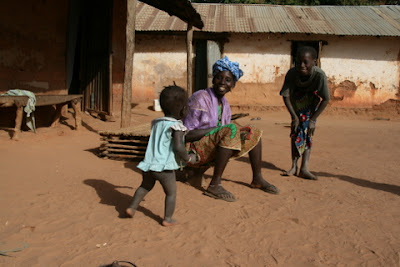
Binta's first steps.
TV Dinners
In the States, one of my parents strictest rules was no TV during dinner. Who would have thought I would travel halfway accross the world to break it. Coming to Africa I never expected to watch TV, but my compound owns a TV, and my host brother owns a solar panel so he can charge the battery to run the TV.

Notice the TV in the middle of the picture with the battery sitting in front of it.
I have to say it is a surreal feeling when I realize I am watching TV in the open air in the middle of my family compound in Africa - on a 10/11 inch black and white screen. We only get one or two channels which most of the time are in english or french (the villagers do not understand either). We watch TV about 3 nights a week starting before dinner. Most of the village kids come to watch and sit around the TV on benches, stools, or rice bags.When dinner is ready we huddle around the food bowl with the TV in the background. No one watches while they eat, but meals in gambia are always quick, so afterwards everyone goes back to watching. I usually go to bed.
The kids watch TV during the day sometimes and I think they can watch just as much as kids in America. One day I am positive they watched at least 6 hours during the day and then they pulled out the TV that night. One of the programs they watch is about animals from around the world, and they are amazed when dolphins jump out of the water or gorillas fight. Even the women peek in sometimes to watch a bit.
Baby Alex
Ok not baby Alex, but Baby Pateh (my African name). Last week I had a baby named after me. In The Gambia every child is named after a family member or friend which could explain why there are so few names in The Gambia. Seven days after a baby is born, the parents hold a naming ceremony, a big party, for the child. People dress up, eat meat, and sometimes listen to music if the family has more money.
I showed up to one last week in the morning around 11am. I almost missed it because I thought the ceremony was the following day. After I sat around for an hour, the family decided everyone had shown up. I went into the room where a man shaves the baby's head. In this case he only shaved a little hair in the front and a little in the back ( it depends on the family, but some shave the whole head). Usually only women watch the baby's head being shaved. Then I went outside and sat with all the men on mats and chairs to pray for the baby. After prayers the father decided the name of the baby to be Pateh after me. Even though I have heard they sometimes name the baby after people with more money so they get presents, I was honored. The men passed out Kola nuts, a bitter nut which gambians like, and the prayers were over.

Baby Pateh and his parents.
Since the father picks the name of the child, the mother sometimes picks a separate name for the child. In that case the child has two names. My father is called Mamadou, his mother's name, which is used by my family, but in the next village people call him Habli, his father's name. Depending on the region of the country the mother's or father's name is preferred.
Next everyone sat around drinking attaya and talking while the women cooked the meal. Right after prayers we were served coos and sour milk with sugar (which I now really like). I remember the first time I had sour milk in training village I almost vomited, but I have grown to like it. Sour milk is milk left to stand for at least a day. It is chunky and on the fourth day goes bad. In the evening we ate the main meal. Depending on the wealth of the family they kill a chicken, goat or ram. In this case they slaughtered a goat. The goat tasted really good since I never get meat in village. As it got dark I rode my bike home.
Sunday, March 9, 2008
Resurrecting a Library
Even though I am an environment volunter, many of us choose to work in the local schools especially during the first three months because teachers speak English, and we can work in the garden or help teach classes. I went to help at a school in the next village (my village has no school). At first I went to help in the lower basic school (grades 1-6) because it was something different than sitting in my village all day long. There I have been learning more about Gambian culture and the local community through their teachers.

One problem was that I did not really know what to do when I went. The garden master did not need encouragement because he has a great garden of carrots, green onions, eggplant, cabbage, and tomatoes. A few children are assigned to a bed and they are in charge of watering, weeding, and planting. The school sells the vegetables to earn a little extra income and puts the vegetables in the lunch food bowls. I suggested I could teach in the classrooms, which the headmaster said was good, but he did not give me any instruction as to what I should teach or which grades. He just said "go". The kids also do not speak english well. So far I have not taught a class, but I plan to in a couple of weeks, about deforestation in the Gambia.

After inquiring about their library I figured out what I wanted to do. Now my project and reason for going to the school is to resurrect the library. Their library was a big dusty cobweb room filled with books stacked on tables at one end of the room. The rest of the room was empty except for an old chalkboard with some numbers and a date from 2005. The room looked like it had not been used in months. I started by going through the books. Most of them are targeted for beginners which is good, and they had some basic math books which look promising. They also had two boxes of which on top were written "Geography Discard." The books are all written before 1975 and have titles such as Surveys for town and Country Planning and Intro to Geomorphology. I am sure a library in England decided they no longer wanted these books and decided to donate them, a worthy decision, but why the books ended up in a primary school in the Gambia I do not know. I asked the teacher in charge of the library about the books and he said they were important because the teachers could read them. Current volunteers said schools will always ask for more books because they can show off how many they have. It is a source of pride. The usefulness and how much they are used are usually not considered.

Inside the library
The kids have an hour lunch break where they have the opportunity to go into the library. The librarian does not open the room unless I am there. I try to go twice a week. The other days he chooses not to open it. At first the kids were hesistant to come in, but by the second week a bunch of kids came. They look mostly at the pictures instead of reading, but some do read and at least they are exposed to the outside world of knights, planes, and exotic animals. Recently I have decided to work on math. I write problems on the board and the kids solve them. I realized the kids even in grade 5 and 6 still have trouble doing basic addition and subtraction problems. I have seen some interesting counting methods from drawing lines on the board to moving from their hands to their toes to counting on their chest and thighs. I think I want to work on math skills because if the kids stop school, the english they learn will be useless, but math they will use in their everyday lives. I want to start a math competition when I get back. I am hoping it will motivate the kids to study outside of class. As a reward I am going to let them draw with my crayons and markers.
 The room is extremely bare. I am going to try to brighten the room up by posting fliers on the walls including maps, pictures of the sun, moon, and earth, and other stuff that would expose the kids to the outside world and stimulate them to learn. Any ideas would be appreciated.
Round 2
 Me in my garden
 The first three months I have had little work to do. I decided to turn my backyard into a garden. Since a clay wall fell down in my small back yard years ago, the ground is extremely hard. When I arrived in village, I immediately went to work building a compost pit of grass, cow dung, and mango leaves. I then made a small garden bed planting cucumber, tomato es, bell pepper, carrot, and eggplant. They germinated nicely and I was excited about the potential of giving vegetables to my family to show the benefits of gardening (currently nobody in village has a dry season garden). But I should not have jumped to conclusions because two weeks later, the birds attacked. They ate everything but three small cucumber plants which they continue to nibble on until today so the plants cannot grow. My family told me to put thorny branches and plastic bags, but to no avail, the birds kept coming.
Round 1: Birds win
I did not want to give up so soon because how can I convince the villagers to garden if I give up so easily. For round two, I decided I would try an onion bag to cover the bed. It would give the plants a chance to grow and I did not think the birds would eat older leaves. I planted carrots and transplanted some eggplants from the local school. I thought I had a good plan. I even planted some trees to transplant later into pots. Unfortunately it was not a fool pr oof plan. As the carrots grew, they grew through the holes in the onion bag. The birds now sit on the onion bag and eat the leaves. I tried stringing cassete tape over the beds, but it did not help. At night the frogs dig around uprooting the carrots. One night I counted over 30 frogs in a bed 1.5m by 1m. Also, my eggplant attracted a small bug that caused them to get sick and even though I used a local pesticide made from tree leaves, it did not work. Also, about 1/3 of my tree seedlings would mysteriously die from morning to night. They were healthy when I woke up and by night they were all shriveled up. I suspect termites.
Round 2: Still undecided - Edge animals
For round three I am planning to put a mosquito net over the beds to stop my biggest problem - the birds.
 es, bell pepper, carrot, and eggplant. They germinated nicely and I was excited about the potential of giving vegetables to my family to show the benefits of gardening (currently nobody in village has a dry season garden). But I should not have jumped to conclusions because two weeks later, the birds attacked. They ate everything but three small cucumber plants which they continue to nibble on until today so the plants cannot grow. My family told me to put thorny branches and plastic bags, but to no avail, the birds kept coming.
Round 1: Birds win
I did not want to give up so soon because how can I convince the villagers to garden if I give up so easily. For round two, I decided I would try an onion bag to cover the bed. It would give the plants a chance to grow and I did not think the birds would eat older leaves. I planted carrots and transplanted some eggplants from the local school. I thought I had a good plan. I even planted some trees to transplant later into pots. Unfortunately it was not a fool pr
 oof plan. As the carrots grew, they grew through the holes in the onion bag. The birds now sit on the onion bag and eat the leaves. I tried stringing cassete tape over the beds, but it did not help. At night the frogs dig around uprooting the carrots. One night I counted over 30 frogs in a bed 1.5m by 1m. Also, my eggplant attracted a small bug that caused them to get sick and even though I used a local pesticide made from tree leaves, it did not work. Also, about 1/3 of my tree seedlings would mysteriously die from morning to night. They were healthy when I woke up and by night they were all shriveled up. I suspect termites.
Round 2: Still undecided - Edge animals
For round three I am planning to put a mosquito net over the beds to stop my biggest problem - the birds.
Subscribe to:
Posts (Atom)

